How People and Culture Risk Travels Through the Enterprise: Pathways to Business Outcomes
Examining the impact pathways that connect internal organizational dynamics to measurable business consequences.
Risk exists where uncertainty about future events creates the possibility of adverse consequences for business objectives. Accordingly, risk management focuses on how sources of uncertainty influence the achievement of those objectives and on designing controls to keep variability within defined tolerance levels. Organizations operate through structures shaped by people and culture, and these structures are integral to how risk manifests in practice. Examining how internal organizational and cultural dynamics contribute to business outcomes is therefore essential to disciplined risk practice.
This article examines the pathways that connect the internal dynamics to measurable business impact.
Organizational Design as a Source of Operational Uncertainty
Business objectives, whether they relate to growth, cost efficiency, compliance, or innovation, are realized through coordinated human action. Unlike deterministic machines, human-operated organizational systems exhibit the following characteristics:
- Adaptive - people interpret incentives and conditions uniquely.
- Distributed - outcomes emerge from multiple interacting roles and functions.
- Contextual - organizational norms and informal practices shape behavior.
- Latent - structural weaknesses may remain hidden until exposed by growth, stress, or adverse events.
People and culture risk is better understood through recurring organizational patterns than through isolated events.
A growing body of empirical research supports the connection between internal organizational conditions and measurable outcomes. Evidence from field research shows that corporate culture influences ethical behavior, risk-taking, and financial reporting practices (Graham et al., 2022). In safety science, meta-analytic findings demonstrate that safety climate is statistically associated with accident frequency and operational safety performance (Clarke, 2006). Research on financial misconduct further shows that internal governance failures can lead to substantial regulatory penalties and firm value loss (Karpoff et al., 2008).
Together, these findings indicate that internal organizational conditions are systematically associated with measurable differences in financial, regulatory, and operational outcomes. In risk terms, this means that people and culture are not peripheral concerns; they are structural contributors to outcome variability.
What an Impact Pathway Is
A practical way to understand impact pathway is to trace how organizational design choices translate into business consequences over time.
That progression typically unfolds in four stages:
1. Organizational Design Features
Every organization defines decision and approval rights, reporting lines, performance metrics, escalation rules, and coordination structures among others. These design choices shape how work is aligned with enterprise objectives.
In areas where reliability is critical such as compliance, safety, financial reporting, or customer commitments, organizational structure needs to support consistent standards and timely coordination. When accountability is unclear, incentives conflict, coordination is fragmented, or issue resolution is delayed, alignment with enterprise objectives weakens. Over time, this misalignment can affect the organization's ability to deliver consistent outcomes.
2. Behavioral Responses
When design features create friction or ambiguity, people adapt. Teams may prioritize local metrics over enterprise outcomes, bypass formal controls, delay resolution of emerging issues, or optimize for short-term objectives in ways that create tension with broader enterprise requirements.
These adaptations are often rational responses to the structure they operate within, but can introduce inconsistency at the enterprise level.
3. Execution Variability
Over time, these behavioral responses create inconsistency in delivery: missed handoffs, uneven quality across business units, compliance gaps, delayed issue detection, rework, or duplication of effort.
Execution becomes less predictable. The risk emerges when execution variability exceeds defined tolerance for the objective being delivered.
4. Business Consequences
Eventually, execution variability appears in measurable outcomes - regulatory findings, operational disruptions, cost overruns, customer attrition, earnings volatility, or strategic underperformance.
The observable business consequence is the final stage of a sequence that began in the organization's design.
The key point: visible business outcomes are the end of a progression that began within the organization's operating structure. Focusing only on the outcome obscures the structural drivers that increased its likelihood. The purpose of mapping impact pathways is to identify where organizational design allows variability to accumulate beyond acceptable limits for critical objectives.
People & Culture as Part of Enterprise Risk Architecture
In mature risk practices, non-financial risks are incorporated into risk management practices alongside financial and operational exposures. For example:
- Operational risk monitoring extends beyond realized losses to include control failures, process deviations, and near-miss events.
- Enterprise risk management frameworks catalogue strategic, operational, financial, and compliance risks among others, assess their likelihood and impact, and define mitigation actions.
- Regulatory and investor expectations require disclosure of human capital and conduct-related risks within risk reporting.
However, while people and culture are acknowledged within these categories, the pathways through which organizational dynamics influence risk exposure are often treated implicitly rather than explicitly.
Regulatory developments, including enhanced human capital disclosure requirements under SEC rules, reflect investor expectations that human capital factors could be material to business performance. Although firms retain discretion in how such information is presented, the requirement itself signals that human capital is recognized within the broader enterprise risk landscape.
Early Visibility Beats Late Outcomes
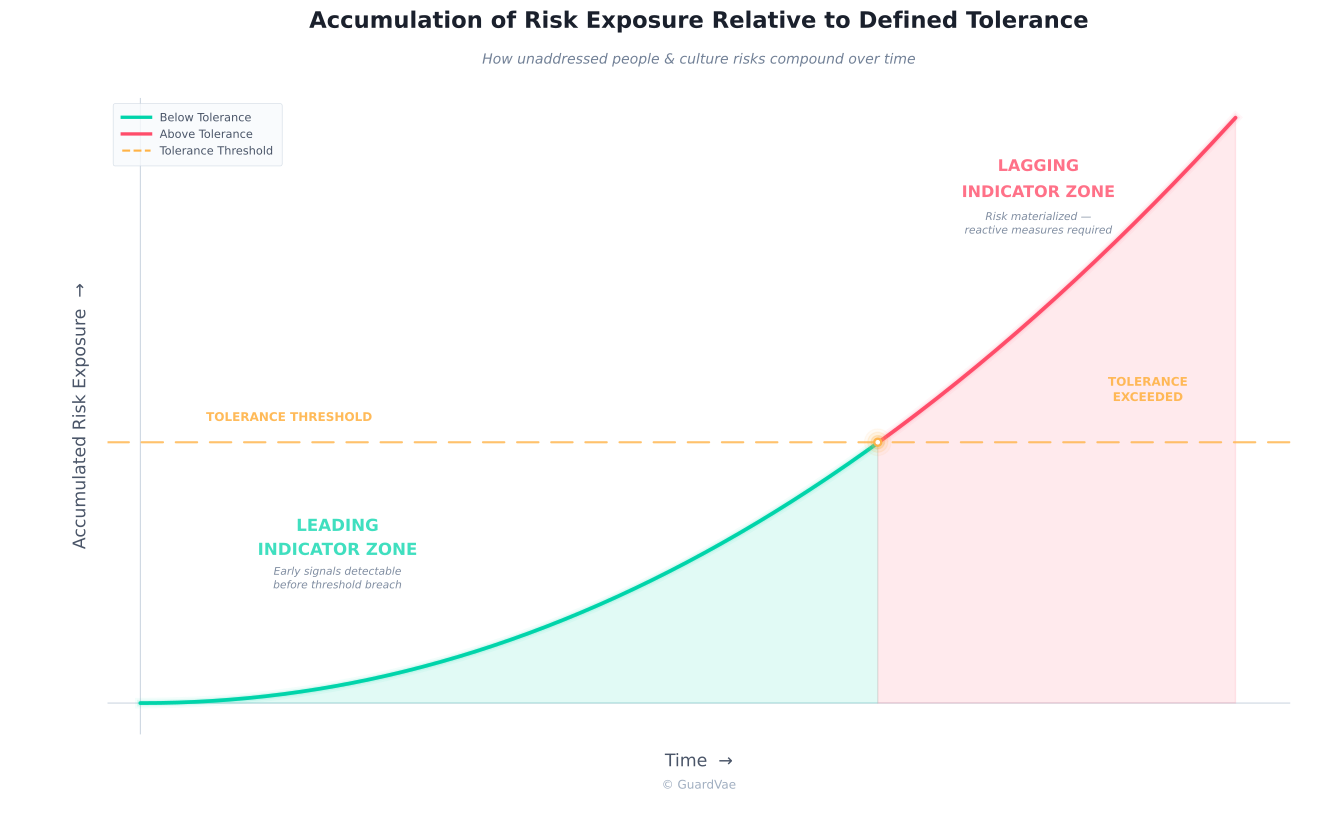
A key reason impact pathways matter is that people and culture challenges accumulate before outcomes become obvious. If monitoring focuses only on outcome failures (for example, customer churn, regulatory penalties, missed financial targets), it misses the upstream uncertainty dynamics that created them.
Impact pathways help to:
- Diagnose sources of uncertainty.
- Establish measurable tolerance limits for internal risk indicators before business performance is affected.
- Initiate corrective action while variability remains within manageable bounds.
Within enterprise risk practice, internal organizational exposures and early disruptions serve as leading indicators, while realized business and financial impacts represent lagging indicators.
Conclusion: Building Discipline Around People and Culture Risk
People and culture are structurally connected to business outcome uncertainty through identifiable mechanisms - impact pathways - that can and should be examined within enterprise risk practice.
By mapping how variability in organizational design, internal coordination, information flows, and cultural norms influences objective delivery, risk professionals can:
- Integrate people and culture risks into enterprise risk registers.
- Detect emerging execution variability before it affects performance.
- Define tolerance limits for internal risk indicators tied to business objectives.
- Prompt timely management attention while risks remain manageable.
- Reduce surprise and improve execution reliability.
Understanding and managing these pathways strengthens the organization's ability to pursue its objectives with greater stability and confidence.
References
Clarke, S. (2006). The relationship between safety climate and safety performance: A meta-analytic review. Journal of Occupational Health Psychology, 11(4), 315–327. https://doi.org/10.1037/1076-8998.11.4.315
Graham, J. R., Grennan, J., Harvey, C. R., & Rajgopal, S. (2022). Corporate culture: Evidence from the field. Journal of Financial Economics, 146(2), 552–593. https://doi.org/10.1016/j.jfineco.2022.07.008
Karpoff, J. M., Lee, D. S., & Martin, G. S. (2008). The cost to firms of cooking the books. Journal of Financial and Quantitative Analysis, 43(3), 581–611. https://doi.org/10.1017/S0022109000004221