PCRM as an Emerging Formal Risk Domain
PCRM requires the same discipline applied to IT, financial, operational, and other risk domains: structured identification, rigorous assessment, continuous monitoring, and reporting.
Across organizations of every size and sector, enterprise risk conversations have long been dominated by financial, compliance, IT, operational and other risks. Organizations invest heavily in audits, and compliance mechanisms - all designed to protect the business from known and measurable threats.
However, in an environment defined by increasing complexity, speed, and interdependence, traditional risk disciplines alone are no longer sufficient. The deepest sources of organizational fragility, and the greatest levers of long-term success often lie in the invisible contours of behavior, norms, communication, incentive system, and overall culture.
People are the operators / drivers of any business. The culture and the people in organizations are leading determinants of strategic outcomes shaping innovation velocity, operational quality, customer trust, and organizational resilience long before financial metrics reveal impact.
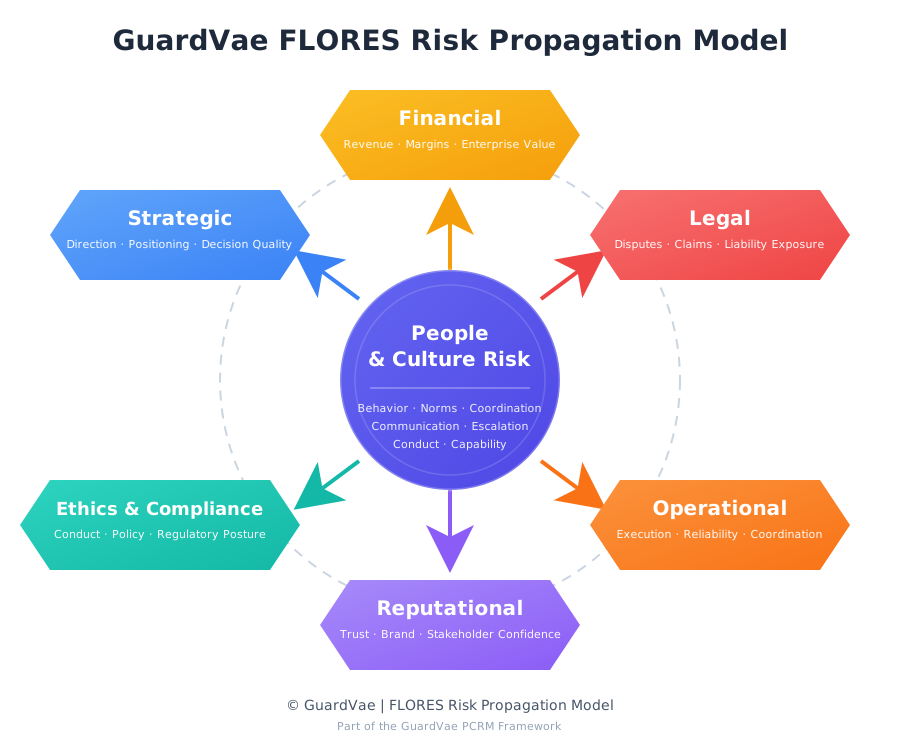
When People & Culture are not seen strategically, it exposes the organization to various financial, legal, operational, reputational, ethics & compliance, and strategic risks - what we at GuardVae call 'The FLORES Risk Dimensions' part of our broader FLORES Risk Propagation Model (illustrated above). People & culture risks propagate across all six FLORES dimensions of enterprise risk.
Some examples:
- Persistent incentive misalignment and execution withdrawal in delivery-critical teams degrade delivery discipline, increasing the probability of missed milestones and quality failures. These conditions directly elevate contract risk, weaken client confidence, and translate into recurring revenue loss and reduced lifetime customer value.
- Fragmented information flows and weak cross-functional co-ordination distort enterprise-level risk visibility and strategic coherence, causing teams to pursue misaligned priorities and execution paths. These conditions increase the probability of flawed strategic decisions, failed initiatives, and long-term erosion of organizational performance.
- Weak internal reporting norms delay detection of internal misconduct allowing issues to accumulate beyond containment thresholds. These conditions increase the probability of public incidents, regulatory attention, employee attrition, and erosion of talent market attractiveness.
- Inconsistent application of ethical standards and workplace policies weakens clarity and control discipline across teams, increasing the frequency of policy deviations and compliance breakdowns. These conditions increase the probability of regulatory exposure, supervisory scrutiny, and loss of confidence in internal governance.
- Unresolved workplace conflicts, discrimination, and safety concerns weaken internal resolution mechanisms and escalate adversarial behavior, increasing the likelihood of formal complaints and employee claims. These conditions increase the probability of litigation, rising legal costs, management distraction, and long-term liability exposure.
- Weak execution reliability, declining conduct quality, and poor coordination discipline increase operational disruption and cost leakage across multiple channels, including project overruns, quality rework, penalties, claims, and lost productivity. These conditions increase the probability of revenue volatility, margin erosion, and sustained pressure on financial performance.
Despite their impact, people and culture risks remain largely unmanaged as a formal risk domain. They are fragmented across HR, compliance, audit, and leadership development treated as engagement issues, conduct issues, or talent issues rather than as systemic enterprise risk drivers. As a result, organizations detect consequences only after execution fails, disputes arise, regulators intervene, or financial performance deteriorates, long after the originating risk had already propagated.
Recognizing and formalizing these patterns as a dimension of enterprise risk - what we call People & Culture Risk Management (PCRM) - is no longer optional. It requires the same discipline applied to IT, financial, operational, and other risk domains: structured identification, rigorous assessment, continuous monitoring, and board-level reporting.
In a world of accelerating complexity, distributed execution, and artificial intelligence-augmented systems, the primary source of enterprise advantage and enterprise fragility remains human judgment, coordination, and conduct. Organizations that can see these risks early, understand their propagation, and manage them deliberately will not only prevent failure but will outperform, adapt faster, and become more resilient.